
Tempered Glass Breakage Explained: Obtuse-Angle Grains and Occasional Self-Destruction
Tempered glass is thermally toughened soda-lime silicate safety glass, and its most important safety property only becomes visible when the pane fails. A tempered pane does not break into long, knife-like shards. It releases the energy stored in its stress field as a dense pattern of small granular fragments with blunt, obtuse-angled edges. The same stored energy also explains why a tempered pane can, in a small number of cases, shatter with no visible impact at all — an event generally described as spontaneous breakage or self-destruction.
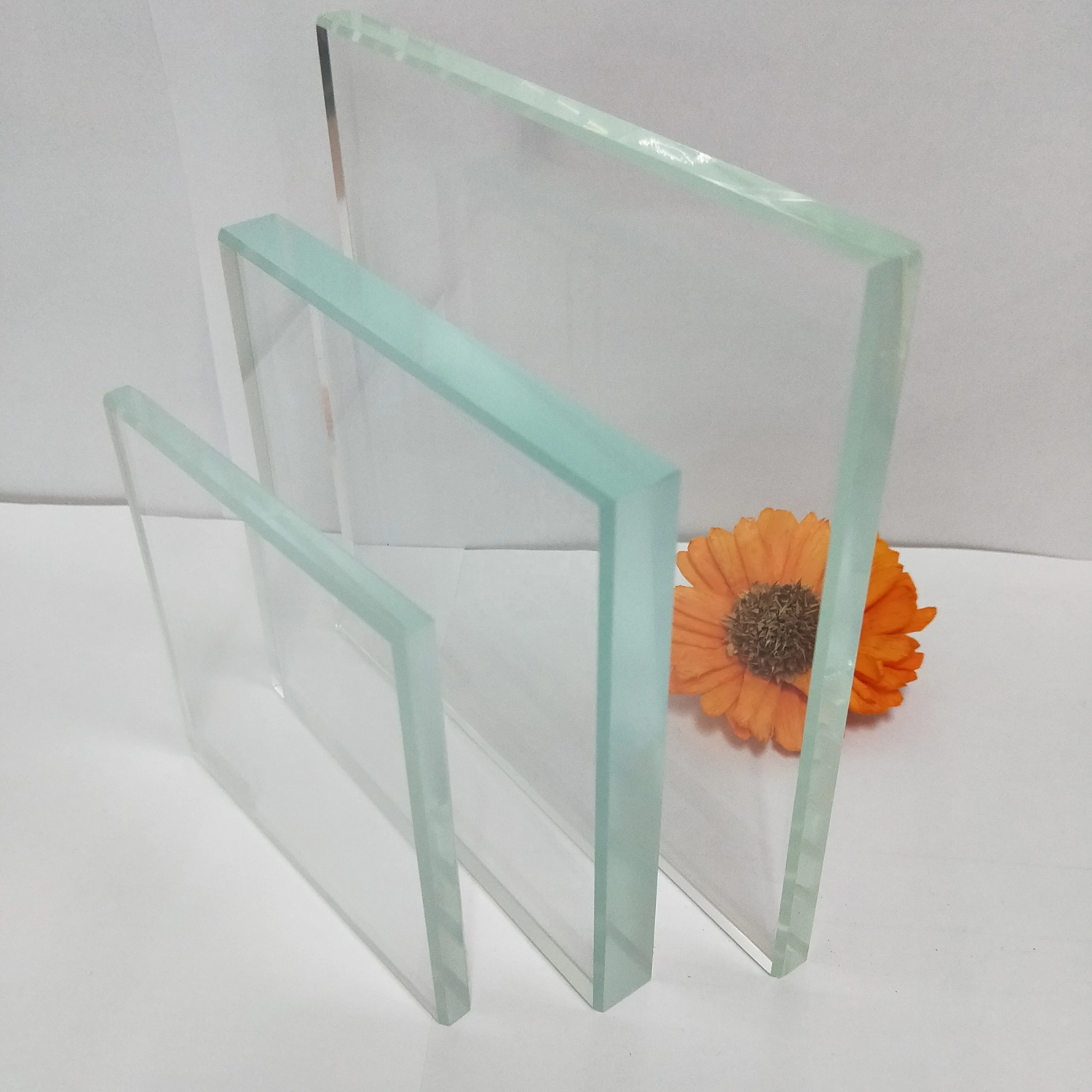
Low iron glass. Reducing iron content is one of the material-level measures used alongside heat soak testing to limit inclusion-related breakage risk in tempered glass.
For architects, facade specifiers and procurement teams, both behaviours need to be understood before the glazing schedule is frozen. Tempered glass cannot be cut, drilled or edge-worked after toughening, so every decision taken at specification stage is effectively permanent. This explainer sets out what the material is, what its documented parameters actually mean, how the obtuse-angle grain pattern should be read, and how occasional self-destruction is managed in practice.
What Tempered Glass Is and What Its Parameters Mean
Tempered glass — also known as toughened glass — begins as a float glass sheet that has already been cut to size, edge-worked and, where required, drilled or shaped. The finished sheet is heated and then quenched rapidly with air. Because the surfaces cool before the core, the outer layers are locked into permanent compression while the centre of the sheet remains in tension. Three documented parameters describe the result:
- Surface compressive stress: 95 MPa — the pressure locked into the glass surfaces, and the reason the material resists wind load, thermal gradient and impact far better than annealed glass of the same thickness.
- Bending strength: 150 MPa — the flexural capacity a specifier can work with when sizing spans, supports and fixings.
- Thermal stability: 250°C to 320°C — the range over which the pane tolerates temperature difference without the thermal shock that would crack ordinary glass.
Thickness is the other parameter that shapes both performance and breakage behaviour. Tempered glass is produced from 4mm up to 25mm, with 6mm tempered glass, 10mm tempered glass, 12mm tempered glass and 19mm tempered glass being the sizes most often written into building schedules. The product family built on that base includes clear tempered glass, frosted tempered glass, tinted tempered glass, low iron tempered glass, insulated tempered glass, tempered laminated glass, double glazed tempered glass, bent tempered glass, curved tempered glass, beveled tempered glass and custom cut tempered glass for door and window applications.
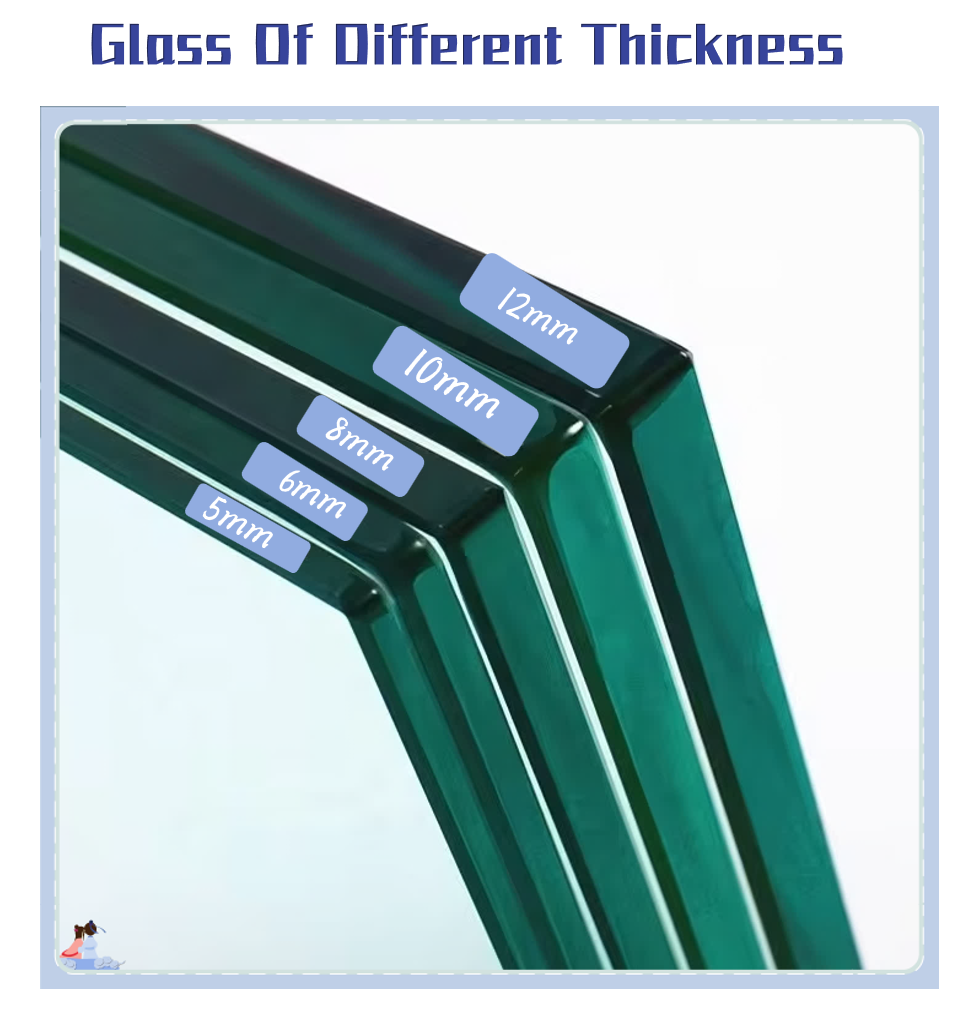
Clear tempered glass supplied across the standard 5mm to 12mm band, part of a thickness range that extends from 4mm to 25mm.
In short: surface compression explains why tempered glass carries load, and the same compression explains what happens when it stops carrying load. The two facts belong together.
The Problem: Breakage Behaviour Is Decided at Specification Stage
Most breakage-related disputes in building projects are not about whether the glass was strong enough. They are about expectations. Two assumptions cause most of the difficulty.
The first is that tempered glass is unbreakable. It is not. Every tempered pane carries a stored stress field, and when that field is released, the pane breaks completely and immediately rather than cracking progressively the way annealed glass does.
The second assumption is that safety glass means the pane stays in the opening after breakage. It does not. Tempered glass fragments and falls; the fragments are small and blunt, but the opening becomes unglazed. Where post-breakage integrity is required — overhead glazing, skylights, balustrade infill, areas below a fall line — the specified build-up is usually laminated glass or tempered laminated glass, in which fragments remain bonded to an interlayer.
Those two corrections lead directly to the questions a specifier or buyer should be able to answer before ordering: what fragment pattern will this product produce, will the pane remain in place, and is spontaneous breakage a realistic risk for this application and these units?
Industry Background: A Material Specified at Global Scale
The reason these questions recur across so many projects is simply how much tempered glass is specified. The global tempered glass market was valued at USD 112.21 billion in 2024 and is projected to reach USD 159.27 billion by 2033, according to Grand View Research. Asia Pacific accounted for 59.9% of 2024 revenue, driven by urbanisation and infrastructure construction. Plain tempered glass alone represented 64.5% of market revenue in 2024 because of its wide use in construction and automotive applications.
Supply is concentrated in the same regions that consume it. China's exports of tempered safety glass reached approximately USD 3.58 billion in 2024, covering more than 647 million square metres, according to UN Comtrade. Market-size estimates vary between research houses depending on which glass types and processing levels they include, so absolute figures are best treated as scale indicators rather than precise totals. The direction of travel, however, is consistent.
Regulation has developed alongside that volume. EN 12150-1:2015, the European standard for thermally toughened soda-lime silicate safety glass, defines fragmentation characteristics — shattering into small pieces of roughly 5mm and below — and thermal resistance up to 300°C. In practice this is the standard against which a tempered claim is usually tested, and it is the reference buyers have in mind when they ask for EN 12150 tempered glass.
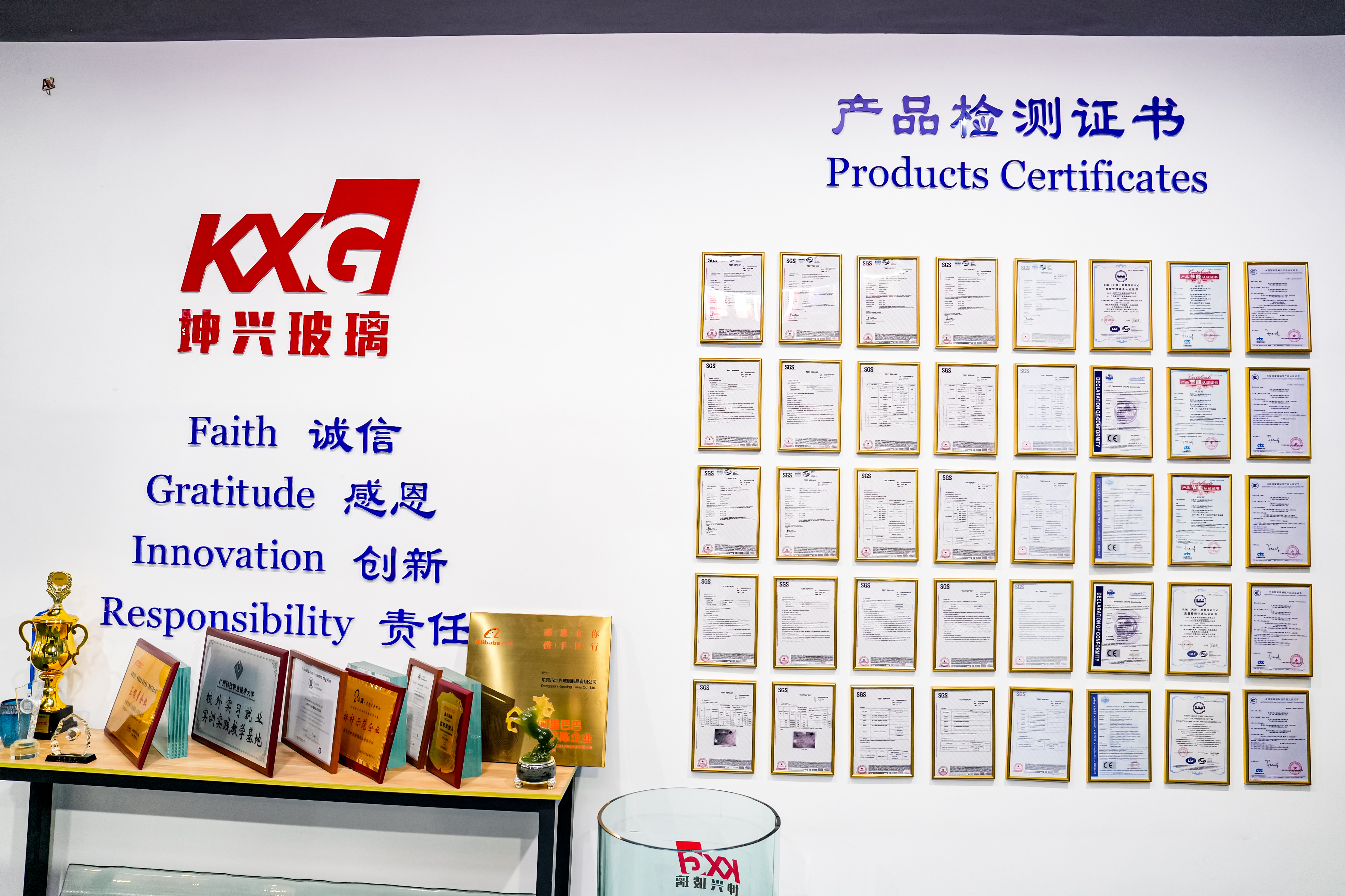
Company identification and certification documentation displayed together at the KXGLASS facility.
Obtuse-Angle Grains: Reading the Fracture Pattern Correctly
When a tempered pane fails, the compressive surface layers release first and the tensile core separates along a large number of small crack fronts at once. The result is not a few large shards but hundreds of small, roughly granular pieces whose edges are blunt rather than acute. That is what obtuse-angle grains describes: fragments whose corners and edges are obtuse, not needle-sharp.
The pattern is a safety feature for two reasons. First, the fragments present far less laceration risk than the long, sharp splinters produced by annealed glass, which is the core of the safety-glass argument in doors, windows, partitions and facades. Second, the pattern is diagnostic: fragment density and shape are among the physical checks used to confirm that a pane really was tempered rather than simply supplied as safety glass.
Two boundaries matter, though. The obtuse-angle pattern describes how the glass breaks, not what happens afterwards — a fragmented pane has no residual load capacity and must be replaced. And fragmentation behaviour is only one half of what EN 12150-1:2015 covers; the same standard describes thermal resistance up to 300°C, which supports the description of tempered glass as heat resistant tempered glass in applications such as oven doors, fireplace surrounds and sun-exposed facades.
Edge quality sits alongside fracture pattern as a controllable variable. Polished edges reduce surface roughness to Ra 0.1–0.3 μm and increase edge strength by more than 30%, with less edge chipping and a lower maintenance frequency over the life of the pane. Because a large share of tempered failures begin at the edge, edge specification is a breakage-control decision, not only a cosmetic one.
Occasional Self-Destruction: Real, Rare and Manageable
Spontaneous breakage — sometimes called self-destruction — is the failure of a tempered pane without impact, without thermal shock and without any apparent external cause. It occurs because defects or inclusions present in the raw glass can survive the toughening process inside the high-tension core of the finished pane. When such a defect later releases the surrounding stress field, the whole pane fragments at once.
The honest framing is that this behaviour cannot be reduced to zero in any production process, but it can be managed. Three documented measures address it.
- Heat soak testing (HST). Finished units are heated to 290°C before delivery, which triggers early breakage in glass that contains critical flaws. Flawed panes fail in the factory instead of on the building, and the units that pass are the ones shipped.
- Low iron glass. Reducing the iron content of the base glass is used as a material-level measure in combination with heat soak testing.
- Installation practice. Elastic pads in the frame allow thermal expansion and contraction, while temperature difference across the pane is controlled by keeping air conditioning at 26°C or above in summer, avoiding direct blowing onto the glass, and closing windows during extreme weather.
For a specifier, the practical translation is a procurement question rather than a technical one: ask whether heat soak testing is available for the project's units, and whether it is appropriate given the consequence of failure in that location. The risk profile of a door or interior partition is different from that of a large facade unit installed at height.
Documented Parameters and Their Procurement Meaning
The table below collects the figures that determine both performance and breakage behaviour. Each row states a documented value and what it changes in a specification or purchase decision.
| Parameter | Documented value | Reference | What it means when specifying |
|---|---|---|---|
| Surface compressive stress | 95 MPa | Product parameter | Drives resistance to wind load, impact and thermal gradient; it is also the energy released at breakage. |
| Bending strength | 150 MPa | Product parameter | Sets feasible spans and fixing distances for a given thickness. |
| Thermal stability | 250°C – 320°C | Product parameter | Allows use behind heat sources and on sun-exposed facades without thermal-shock cracking. |
| Fragmentation behaviour | Small pieces of roughly 5mm and below; thermal resistance up to 300°C | EN 12150-1:2015 | Defines the obtuse-angle grain pattern as a standardised outcome rather than a marketing claim. |
| Thickness range | 4mm – 25mm, including 6mm, 10mm, 12mm and 19mm | Product range | Thickness selection balances span, load, weight and hardware; 19mm tempered glass is typically reserved for heavier duty. |
| Heat soak test | Heating to 290°C before delivery | Risk-control measure | Triggers early failure of flawed units in the factory; the standard mitigation for spontaneous breakage. |
| Edge processing | Surface roughness Ra 0.1–0.3 μm; edge strength +30% | Edge comparison data | Reduces edge chipping and lowers the frequency of edge-initiated breakage. |
Step-by-Step: Confirming Breakage-Related Data With a Supplier
The purpose of this sequence is to replace assumptions about breakage behaviour with documented answers. It applies to any supplier, regardless of origin.
- Define the application and the consequence of failure. Door, window, partition, curtain wall, skylight or overhead glazing each implies a different acceptable outcome after breakage. Overhead and fall-protection locations usually require a laminated build-up rather than single tempered glass.
- Confirm the model designation and the standard. Ask the supplier to state exactly which standard the tempered glass is produced and tested against — for example EN 12150 tempered glass — and how that designation appears on submittal documents.
- Request the performance figures in writing. Surface compressive stress, bending strength and thermal stability range. For the range described in this article, those values are 95 MPa, 150 MPa and 250°C–320°C respectively.
- Confirm the thickness selected. State the required thickness in millimetres — 6mm, 10mm, 12mm, 19mm or another value between 4mm and 25mm — and check it against load, span and hardware, since tempered glass cannot be re-worked after toughening.
- Ask about heat soak testing. Confirm whether heat soak testing at 290°C is available for the project's units, and for which units it is recommended.
- Ask about low iron glass. Where base glass composition matters to the project, confirm whether low iron glass is offered and how it interacts with the heat soak regime.
- Verify certification evidence. Check certificates against the destination market: CE EN 12150, SGCC ANSI Z97.1 and AS/NZS 2208 for the corresponding regions, alongside ISO and China 3C certification.
- Confirm edge treatment and fabrication details. Polished edges, cut-outs, holes and shape — including bent or curved profiles — must all be fixed before toughening, and edge quality directly affects breakage frequency.
- Agree the commercial and inspection terms. Confirm minimum order quantity, delivery terms and the inspection basis, so that acceptance criteria are not negotiated after production.
- Confirm continuity of supply. For projects with phased delivery or a long service life, ask for documented production capacity and export experience rather than verbal assurances.
Where This Matters in Practice
Breakage behaviour is easiest to see in projects where processed glass carries both a functional and an aesthetic load.
In a commercial project in the United Arab Emirates, silk-screen printed glass was applied for decorative and privacy-protecting purposes in mall skylights and curtain walls. The project involved 100–200 units and was completed with a service life duration of 2–10 years. Skylight glazing is precisely the location where the does-it-stay-in-place question must be answered at specification stage, because the assembly above the head determines the consequence of any breakage.
In Vietnam, glass was used for airport curtain walls and decorative walls in an installation involving 200–500 units, with a project duration of 3–10 years. Large-scale public infrastructure of this type combines high wind loading, thermal cycling and heavy traffic exposure — conditions under which surface compressive stress, edge quality and thermal stability all become day-one specification decisions.
For door tempered glass and window tempered glass, the same logic applies at a smaller scale. The material behaves the same way; only the consequence of a broken unit changes.
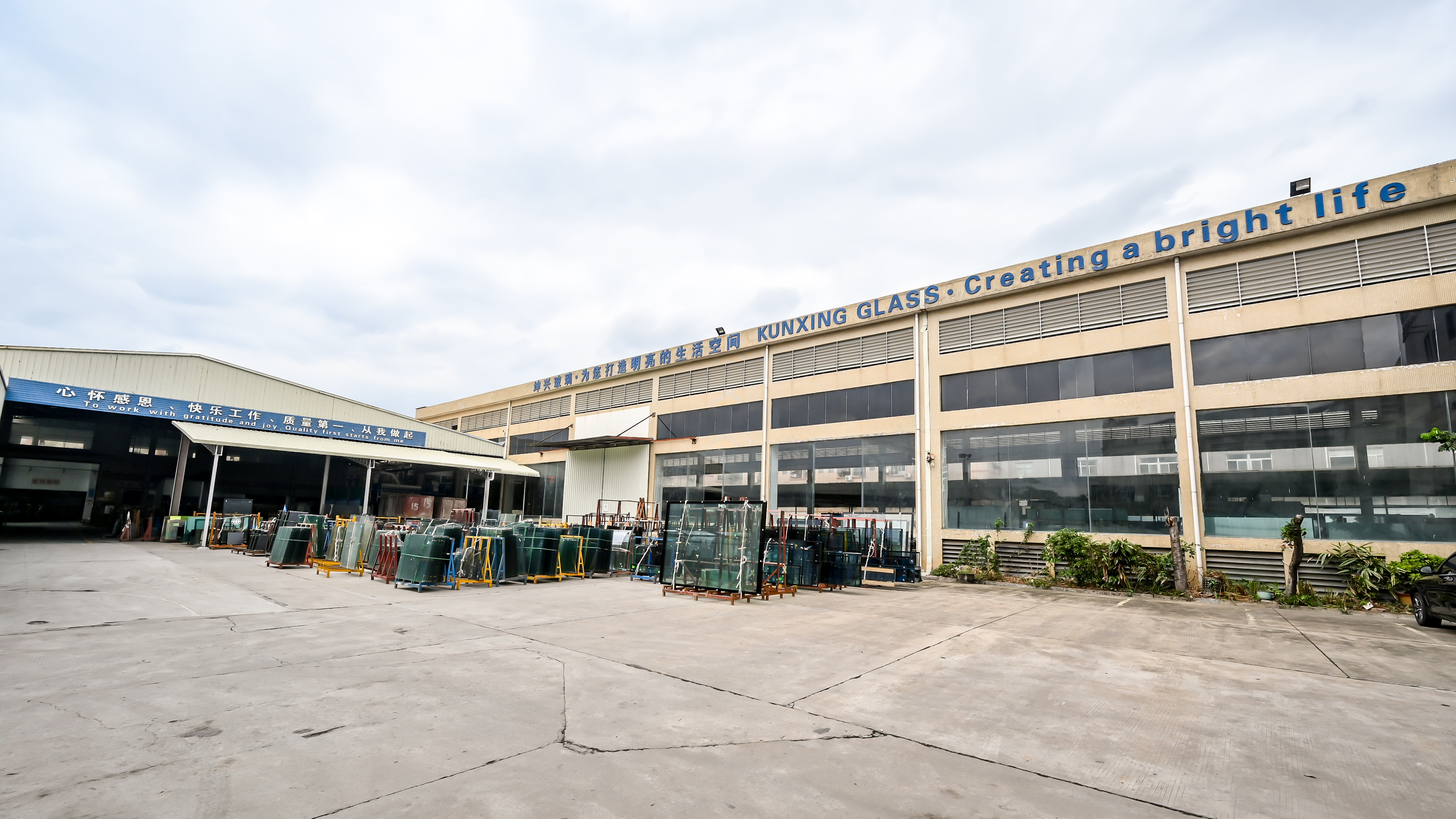
Factory yard at the KXGLASS facility in Dongguan, where tempered units are handled and prepared for dispatch.
Frequently Asked Questions
Which standard defines how tempered glass breaks and how much heat it tolerates?
EN 12150-1:2015 is the European standard for thermally toughened soda-lime silicate safety glass. It defines fragmentation characteristics — shattering into small pieces of approximately 5mm and below — together with thermal resistance up to 300°C. This is the reference used when a project calls for EN 12150 tempered glass. Product certifications for the range discussed here include CE EN 12150, SGCC ANSI Z97.1 and AS/NZS 2208.
Can spontaneous breakage be eliminated completely?
No production process can guarantee zero risk of spontaneous breakage, which is why the controls focus on reducing it. Heat soak testing heats finished units to 290°C before delivery so that glass containing critical flaws breaks in the factory rather than on site, and low iron glass is used as a further material-level measure. Installation practice supports the same goal: elastic pads in the frame allow thermal expansion and contraction, air conditioning is kept at 26°C or above in summer, direct blowing onto the glass is avoided, and windows are closed in extreme weather.
What are the documented commercial starting points for an order?
For the tempered glass range described here, the minimum order quantity is 100㎡, delivery terms are EXW, FOB or CIF, and acceptance is based on pre-shipment testing. Payment terms are 30% TT in advance with 70% balance TT before shipping, with full payment for orders under USD 10,000.
How can a buyer validate thickness and performance before shipment?
Validation rests on documentation plus inspection. Request the written parameter set — 95 MPa surface compressive stress, 150 MPa bending strength and thermal stability of 250°C to 320°C — alongside the selected thickness and any heat soak or low iron specification, then confirm that pre-shipment testing is the agreed acceptance criterion. Any sample or pre-production review should be agreed with the supplier at quotation stage so that it is written into the order rather than requested afterwards.
Is the supply relationship strong enough for a multi-year project?
That depends on documented capacity rather than assurances. KXGLASS (Dongguan Kunxing Glass Co., Ltd.), a glass deep-processing manufacturer based in Dongguan, China, reports a monthly production capacity of 100,000 square metres, an export ratio of 70% and established markets in Australia, America, Asia and Europe, with completed projects carrying documented service-life durations of 2–10 years. For phased or multi-year projects, these are the figures to check. The full specification and certification set can be reviewed in the company brochure, or the team can be contacted directly with the project's thickness, standard and unit count.
Conclusion: Confirm the Data, Not the Assumption
Tempered glass has two behaviours that every specification should account for. It breaks into small, obtuse-angled grains rather than sharp shards — a safety outcome defined by EN 12150-1:2015 — and it may, occasionally, fail without an external cause, which is why heat soak testing at 290°C, low iron glass and correct installation practice exist.
Neither behaviour can be judged from appearance. What a specifier or buyer can work with is documented data: the model designation and the standard it is tested against, the thickness in millimetres, and the performance figures — 95 MPa surface compressive stress, 150 MPa bending strength and thermal stability between 250°C and 320°C. Confirming those items with a supplier, and asking explicitly whether heat soak testing is available, converts an assumption about breakage into a decision that will hold up in service.
For door, window and facade projects, KXGLASS can confirm model designation, thickness and performance data against project requirements — including 6mm, 10mm, 12mm and 19mm tempered glass, EN 12150 tempered glass, and low iron and insulated build-ups.

Dongguan Kunxing Glass Co., Ltd. (KXGLASS) — tempered, laminated and insulated glass processing in Dongguan, China.
Next step: review the full specification and certification set, or send the project's glass schedule for a quotation.
Brochure: Download the KXGLASS product catalogue (PDF)
Website: www.kxglass.com
Contact: Kevin — kevin@kxglass.com — Tel: +86 13500092849
Address: No. 10, Jinchuan Road, Zhaolin, Xiegang Town, Dongguan City, Guangdong Province, China 523590
Have Questions or Need More Details?
Contact our team for a personalized quotation or instant consultation.
Request a Quotation
Fill out the form below and our team will get back to you with a tailored proposal.
WhatsApp Direct Chat
Prefer to chat in real-time? Message us on WhatsApp for instant assistance & quick answers.
- Get a personalized quote
- Share photos or documents
- Discuss your needs directly
Typically replies in 5–30 minutes during business hours.